July 2026 Update
Join us Thursday, July 23 at 6 p.m. at Miller Community Center for the public hearing on this project.
Seattle Public Schools has chosen the option which will have by far the largest negative environmental impact of all the options which were under consideration. See our letter to the Parks Commission below for talking points.
Dear Seattle Parks Commissioners,
Thank you for the opportunity to comment on the proposed Lincoln High School Athletic Field project in Woodland Park. This decision will have consequences that last for generations for one of Seattle's most ecologically significant remaining urban forests. Our chief concerns are:
- The tree loss associated with this project is enormous—at least 79 healthy significant trees on the site itself, with estimated total tree loss likely exceeding 100 trees due to construction impacts in critical root zones of adjacent trees.
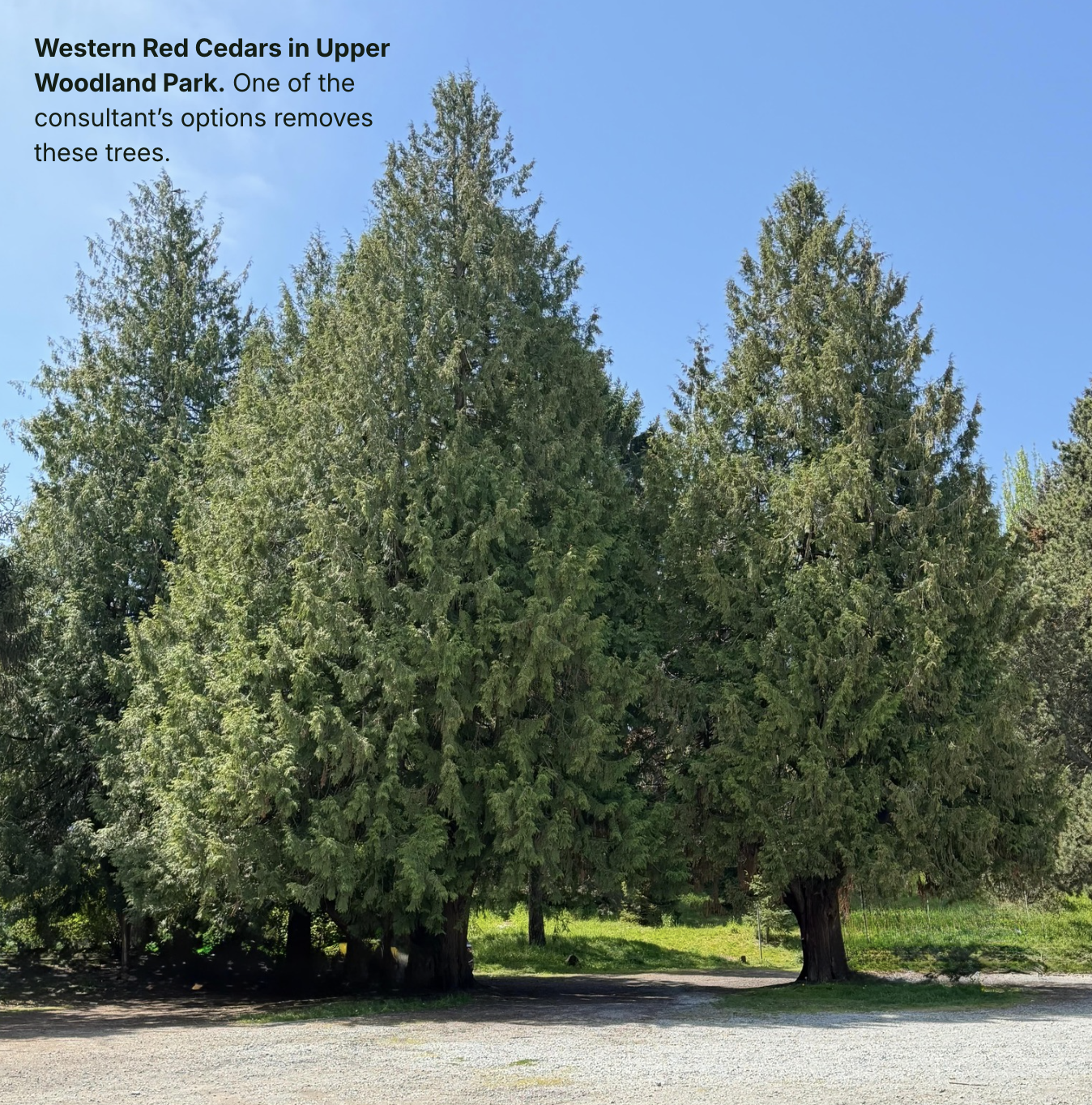
- Many of the trees are native, with some likely original old growth, and part of a contiguous forest system—increasingly rare in Seattle, irreplaceable, and of maximum ecological benefit for urban climate resilience. There is no replacement planting strategy that would replicate the ecological benefits of these mature native trees in our lifetimes.
- Dramatic canopy loss would leave the field exposed to Aurora Avenue—endangering student athletes. The confluence of tree removal impacts, highway exhaust, and heat exacerbation from the artificial turf field itself would create dangerous heat and air quality conditions for the students playing there.
Attached is the arborist report for this project, which was included in Superintendent Shuldiner’s recent announcement. A few notes on the arborist report:
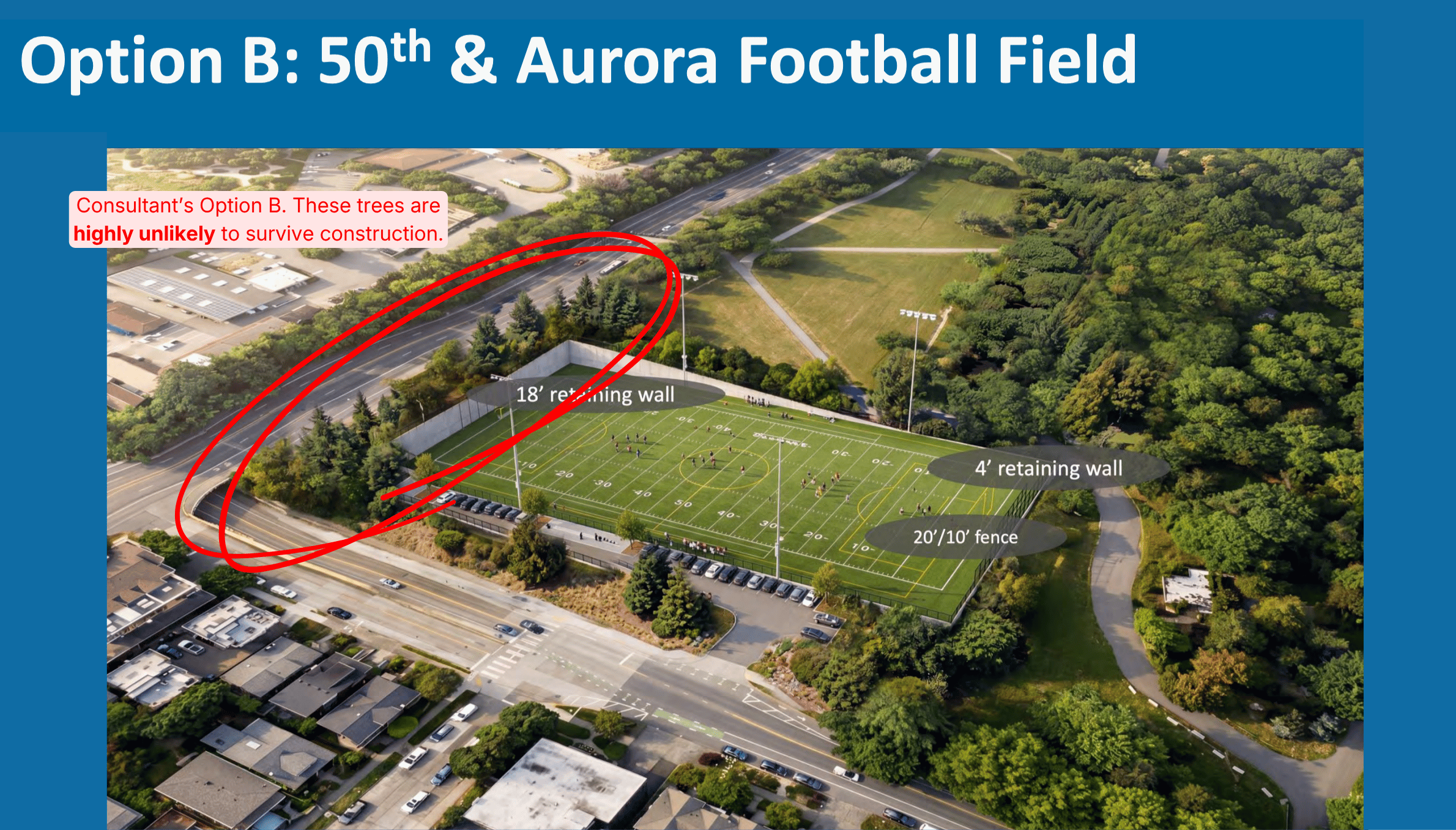
- The only trees listed in this report are the ones in the scope of work for the athletic field. Trees impacted by road expansion, adjacent trees with critical root zone impacts, and trees between the field and Aurora (West of the scope of work outline) are not included, even though these trees would almost certainly die due to construction impacts.
- This field would have an 18 foot high retaining wall level with Aurora and remove the forested hillside bluff, moving 35,000 cubic yards of dirt in the process. It is exceedingly unlikely that any of the trees remaining in the thin stand between the retaining wall and the highway would survive.
- There have been conflicting reports on tree loss associated with this project. We've seen an estimate of 40 trees removed for the preferred option approved by the superintendent, but this does not comport with the site design, observable site conditions, or the arborist report provided. We've asked the district on multiple occasions for the list of the 40 trees (ideally including a project overlay), and were told that no such list exists. It's unclear how this number was calculated.
- It is hard to overestimate the ecological significance of the native trees in and around this lot, a number of which are likely older than the city itself. Even the already significant DSH measurements included in the attached tree table don't provide a complete picture of the loss on site. For example, the Western Red Cedar measured as 57.2" (#61 in the arborist tree table), has a branch that in and of itself exceeds the trunk diameter threshold for Tier 2 tree designation.
- It is never possible in any arborist report to truly account for the cascading negative environmental impacts of tree removals of this magnitude. Younger surrounding trees that have grown up within the canopy cover and mycelial network of these healthy mature trees depend on them to survive, and often die just a few years after adjacent large trees are removed. The heat island impacts of the artificial turf field combined with the exposed highway would severely threaten the health and survivability of trees in the neighboring recreation and forest area.
Additional project context:
- The "community option" proposed by Friends of Lower Woodland Park, while creative and possibly worth exploring, is not an official design nor has it undergone any expert design review. No arborist has been consulted, and so the relatively low number (~20) of tree removals cited in that option is not evidence-based.
- The big leaf maples at this site are of great ecological import. It's misleading to lump "deciduous" in the same category as "non-native" or "dying," as is done in the community option description. Big leaf maples (and many other species of deciduous trees!) are native to this region and critical for ecosystem health and climate resilience. In fact, they often mitigate more stormwater run-off and sequester more carbon (per DSH") than our native conifers.
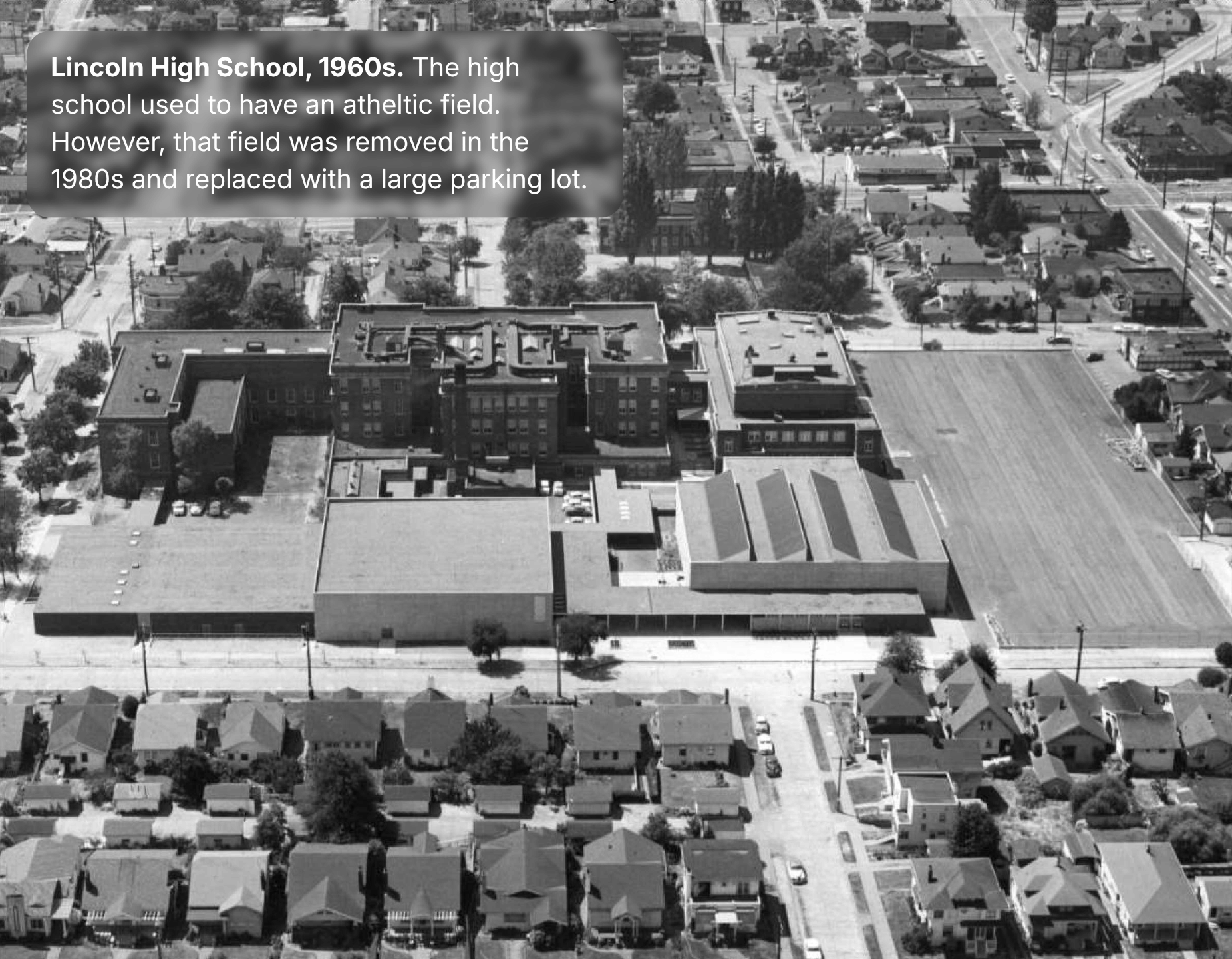
- During a 1980’s remodel, Lincoln High School paved over the athletic field adjacent to the school building, which is now a large parking lot.
Additional context on Seattle's Urban Canopy:
- Our urban canopy is rapidly shrinking. We've had at least 7,000 trees removed since the 2023 tree ordinance on private property alone. Current SDCI code allows developers to clearcut lots and remove even our largest, most significant trees—making it even more critical to protect trees in our public parks and in the public right of way.
- Trees in Seattle lower temperatures by up to 20 degrees in heat waves. Tree loss results in dramatically worse heat conditions, not just because of the loss of shade but because of the year-round moderating impact of evapotranspiration large trees provide.
- It is not possible to "replace" mature healthy trees. We can't replicate the climate conditions that sustained our existing old healthy trees to maturity. We are in our fourth consecutive year of drought, with increasingly frequent heat waves and heat dome events, which is resulting in rapidly dwindling survivability for new trees. Further, new trees take decades (or centuries in the case of old growth!) to provide the same cooling and climate benefits that existing mature trees currently provide. And in those decades, we've lost the compounding benefits the removed trees would have continued to provide if they were retained. Even a 3-1 replacement model does not begin to approach the climate benefits currently provided by mature trees in any near-term horizon.
Thank you for your thoughtful consideration of these concerns. The forest in Woodland Park is one of Seattle's most treasured landscapes, and is a public asset that cannot be recreated once it is lost. We respectfully urge the Commission to carefully weigh the full ecological, public health, and long-term climate impacts of this proposal and to advocate for alternatives that preserve this irreplaceable forest while still meeting the community's athletic needs.
Sincerely,
Tree Action Seattle




.png)