
Subscribe
Take a Step Towards Climate Justice in Seattle.

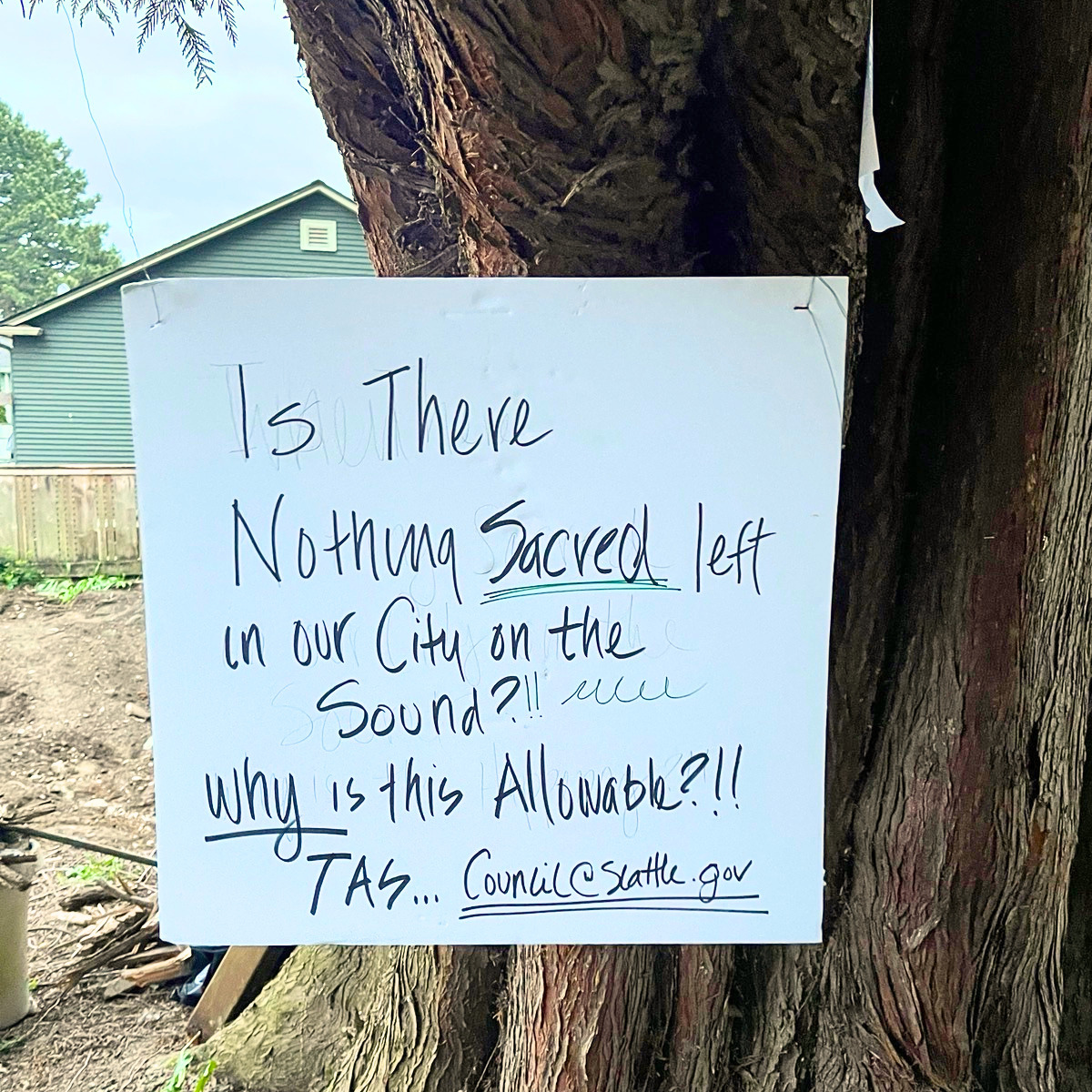
Our Right to Protect is every citizen’s right to an accessible environmental review process that holds city leaders accountable to the facts. City council is voting on the SEPA bill in July, with a hearing July 1. It must be rejected.
Our local environment is more fragile than ever, yet government officials have handled it carelessly from the 2023 tree ordinance (which has fueled the removal of over 7,000 trees) to this latest powergrab.
CB121215 is a council bill sponsored by CM Lin that would eliminate environmental appeals from all City land use legislation and any City building project.
CB 121215 puts Seattle’s trees and ecosystem in danger. Here’s why:
Most Seattleites do not get personal meetings with city officials. But in just January to March this year, the developer lobby had 40 meetings with city leaders, all but two of them private. There were no documented meetings with environmental organizations.
These conversations translate into proposed legislation and influence in our elected officials’ decision making process. Citizen environmental reviews are our chance to push back on that power through our own checks on government.
Seattle's Hearing Examiner process takes far longer than comparable Western Washington cities, where appeals are often resolved in under 60 days. Reform the hearing process instead of eliminating appeals altogether. And if Environmental Impact Statements accurately assessed impacts from the start, there would be little need for appeals.
An appeal to the Hearing Examiner costs $85, and residents can represent themselves. Appeals to Superior court require lawyers and deep pockets.
Once legislation is adopted, environmental assumptions are baked into law and nearly impossible to change. City projects will have already broken ground and removed trees. Appeals give Council the benefit of an independent review before voting on major legislation and City projects–while there is still time to fix errors.
Any argument that these appeals cost time and money falls flat. Over the past decade, Seattle averaged just 2.7 appeals per year, and only 8 of the 27 total appeals involved building housing. Eliminating the public's appeal right to address fewer than one housing-related appeal per year is out of scale.
Seattle's tree ordinance appeals forced disclosure of major deficiencies and previously withheld information about the number of trees at risk in Seattle. Without this appeal, the public would still be in the dark about the potential loss of almost one million mature trees.
CM Eddie Lin, the bill’s sponsor, notes that Tacoma, Everett and Bellevue do not allow appeals, implying Seattle is an outlier. However, the report he references lists Snohomish County, Pierce County, Kent and Spokane as jurisdictions that maintain administrative SEPA appeals for non-project actions. Vancouver and Olympia also maintain SEPA appeals.
As noted by Futurewise, Seattle has consistently led the nation in producing housing. This would not be possible if appeals were holding up housing production.
“From 2010 to 2020, Seattle built more housing (relative to its existing housing stock) than all major American cities except Austin and Denver. Seattle added about 60,000 new homes and did so in an area of only 83 square miles. Austin added 90,000 new homes in 305 square miles. Even more remarkably, Seattle built over 80% of these new homes in just the roughly 15% of land area that are designated “urban villages.” Seattle also built far more homes than its surrounding suburbs. For these reasons, the Seattle region was adding density, while Austin and most other major metropolitan areas were sprawling outward. Housing production in Seattle has even increased since the 2010s. In 2024, Seattle added a net 14,269 new homes. San Francisco, by comparison, added only 1,735 homes last year.”
If Seattle city leaders don’t want to spend time defending the impacts of their legislation on the environment, maybe they shouldn’t be passing it.
Click here, or copy and paste the below text (if you have time, put it in your own words!) to ask city council to vote against CB 121215.
To: council@seattle.gov
Dear Seattle City Council,
Please vote NO on CB 121215. This bill eliminates the public's only affordable way to challenge inadequate environmental review before major legislation and City projects are approved.
The problem isn't environmental appeals, but rather inadequate Environmental Impact Statements and a Hearing Examiner process that needs reform.
Appeals are rare, averaging just 2.7 per year over the past decade, with fewer than one housing-related appeal per year.
Eliminating an important public right is a drastic step which is out of proportion to the problem.
Past appeals have uncovered serious errors and previously undisclosed information that improved public understanding and Council decision-making. Appeals give residents an independent review before environmental assumptions are locked into law and before trees are removed or projects begin.
Please preserve the public's right to independent environmental review by voting NO on CB 121215.
Sincerely,
[Your Name]


.png)